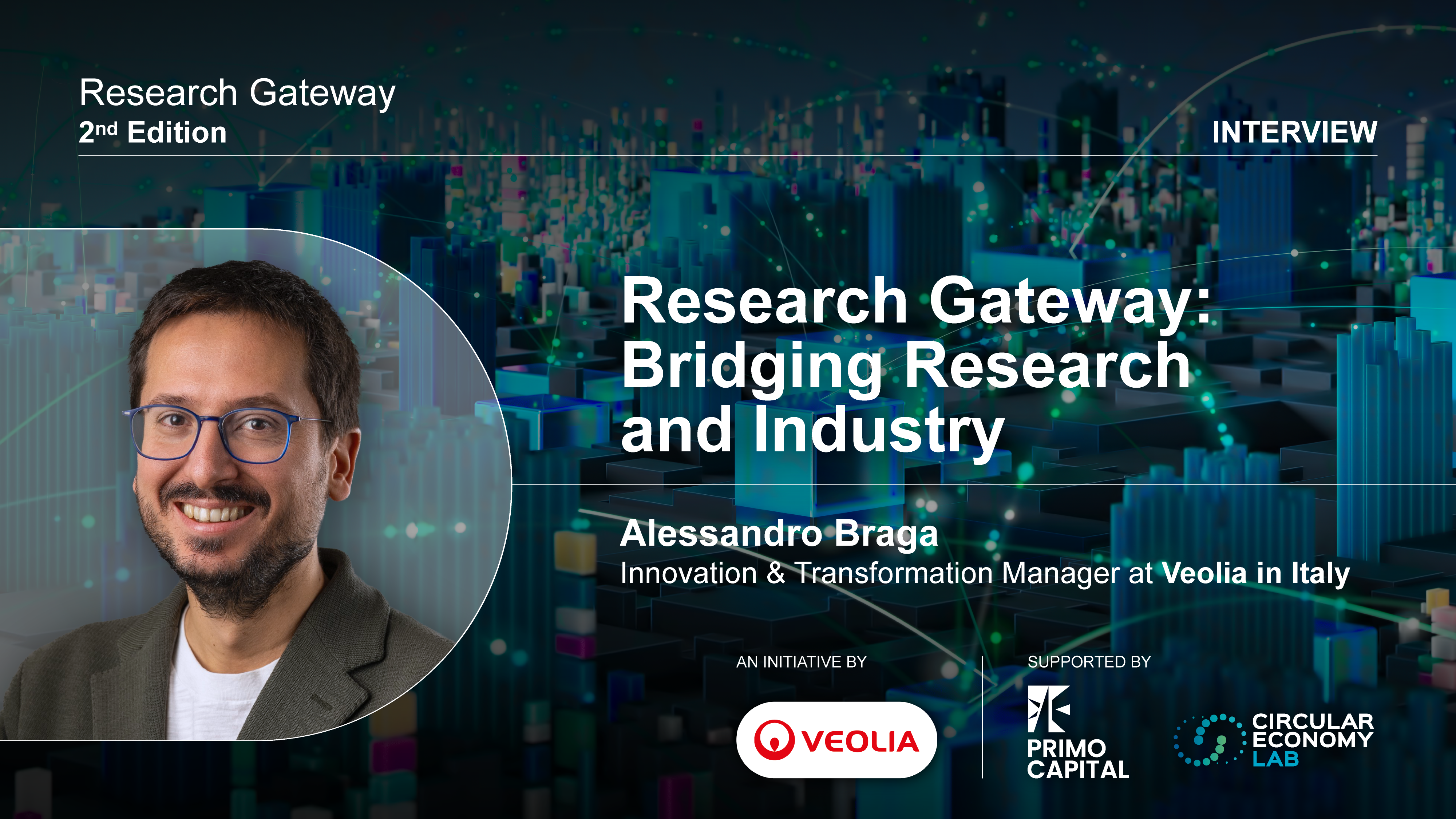
Research Gateway: a bridge between research and industry. Interview with Alessandro Braga
Following a first edition that involved ten innovative projects, Research Gateway returns with a new programme for researchers, university teams, Italian research centres and technology transfer offices developing high-potential technologies or prototypes. Its goal is to connect research with Veolia’s expertise, assets and innovation needs in Italy, creating tangible opportunities for industrial validation and supporting solutions on their journey to market.
We discuss this with Alessandro Braga, Innovation & Transformation Manager at Veolia in Italy, to review the first edition and explore the value and opportunities offered by the new programme.
- Research Gateway is now in its second edition. What need led to the programme’s creation, and what value does dialogue with universities and research centres bring to Veolia?
The programme was created to help bridge the gap between outstanding scientific research and the market, turning academic inventions into tangible, scalable industrial solutions for the energy transition. Many teams have promising prototypes but need entrepreneurial expertise and access to real facilities, both of which are essential for field validation.
For Veolia, this dialogue is a key Open Innovation lever for identifying deep-tech solutions in Smart Energy and indoor well-being that can be integrated into its industrial assets and services. It enables the company to position itself as an industrial partner and early adopter, making its infrastructure available for real-world trials and accelerating the ecological transformation across Italy.
- Looking back at the first edition, what were the main results achieved, both for the selected projects and for Veolia?
The first edition of Research Gateway delivered excellent results, proving to be an initiative capable of generating value both for the researchers involved and for the entire Veolia organisation.
For the selected projects, the programme first and foremost provided significant learning value. Through four intensive sessions in Milan, the teams developed skills in business models, scalability, funding strategies and leadership—essential for turning a laboratory invention into a robust business. Ongoing engagement with leading figures from Italy’s innovation and venture capital ecosystem—including representatives of Almacube and Kilometro Rosso, successful founders, and representatives of Primo Capital and CDP Venture Capital—further enriched the programme. It concluded with two opportunities for international exposure: presenting the solutions to Veolia’s Top Management during the Demo Day in Paris and gaining access to a global showcase such as Viva Technology.
At the same time, the initiative generated strong interest and enthusiasm within Veolia, engaging not only local teams but also colleagues across the Group and its international Business Units. This broad involvement encouraged the search for tangible synergies to develop Proofs of Concept and pilot projects at real facilities. The programme thereby strengthened Veolia’s role as an industrial partner and early adopter, capable of identifying the best deep-tech solutions in Smart Energy and indoor well-being to accelerate the ecological transformation.
- Have any projects from the first edition already launched trials, Proofs of Concept or other forms of collaboration with Veolia? What developments can you share?
We are in discussions with several teams to identify the most suitable settings in which to test their technologies. Because these solutions are at an intermediate level of maturity, it was not possible to begin immediate field validation for every project at the end of the programme. However, we have remained in contact to support the teams in reaching an appropriate level of maturity and to explore potential opportunities for collaboration as soon as they arise.
- Which aspects of the first experience led you to confirm and strengthen Research Gateway with a second edition?
What first encouraged us to confirm and strengthen Research Gateway for a second edition was the exceptional quality of the deep-tech research emerging from Italian universities and research centres, which demonstrated that Italy has an innovation ecosystem of the highest calibre.
This key factor was reinforced by strong momentum within the company: the initiative generated genuine enthusiasm throughout the Veolia Group, actively engaging colleagues and leaders from international Business Units who were highly interested in exploring and applying these solutions at their facilities.
- One of the programme’s distinctive features is the opportunity to bring research closer to real systems, facilities and industrial environments. Why is this validation phase so important in turning a scientific project into an applicable and scalable solution?
Engagement with real industrial environments is essential, above all, to steer the research trajectory towards the sector’s genuine operational needs from the outset. More than simply conducting technical tests or gaining direct access to facilities, its value lies in continuously aligning the scientific vision with the tangible regulatory, economic, operational and integration constraints that shape the market.
Direct engagement with real-world dynamics and processes helps researchers understand what industry truly needs, preventing technological development from proceeding in an abstract or isolated way. This ensures that solutions under development are shaped from the start around the sector’s actual priorities and challenges, creating the essential conditions for scientific research to evolve into innovation that is genuinely applicable, desirable and scalable.
- What is the value of the collaboration with the Circular Economy Lab, and what practical support does it provide in designing and developing the programme?
The collaboration with the Circular Economy Lab is of fundamental strategic value to the success of Research Gateway. From the outset, its support enabled us to launch the first edition extremely quickly, ensuring remarkable operational responsiveness.
In practical terms, the Circular Economy Lab’s value lies in its ability to connect the programme with an extensive, qualified network of universities, research centres and accelerators throughout Italy, ensuring that the opportunity reaches a broad audience. It also provides methodological and hands-on support, helping prospective applicants structure and complete their applications and assisting the selection team in identifying the most promising opportunities.
- What tangible opportunities can Research Gateway offer selected teams, and how will they be able to engage with Veolia’s technical experts and Business Units?
Research Gateway offers selected teams an integrated acceleration programme combining entrepreneurial training, strategic mentorship and international exposure. Through four intensive sessions in Milan, researchers acquire key skills in business models, scalability and funding strategies, supported by technology transfer experts and venture capital representatives.
The key opportunity for engagement with Veolia is the Demo Day at the Group’s headquarters in Paris, where teams present their solutions directly to technical experts, Business Unit leaders and the Group’s Top Management. In addition, one selected team will have the opportunity to attend a Master’s programme in Circular Economy at the University of Exeter.
- What message would you like to share with researchers and research centres considering applying to the second edition of Research Gateway?
I would tell researchers and research centres not to let their ideas remain confined to the laboratory: Research Gateway is a tangible opportunity to turn scientific excellence into industrial solutions that can make a difference. Applying means gaining access to a high-level acceleration and mentorship programme to develop business skills and engaging directly with Veolia’s Top Management and international Business Units. If you are working on a solution in energy efficiency or Smart Buildings, step forward and apply: we are ready to support you on the journey from invention to market.
Take your research beyond the laboratory. If you are developing a high-potential technology or prototype in one of the call’s focus areas, apply to the second edition of Research Gateway by 4 December 2026.
Discover all the details and submit your application